6 Best Heavy Duty Office Chairs (October 2026)
The best heavy duty office chairs include the Indulgear 600 lb Heavy Duty Chair for adjustable support seekers, the MAHOMICO 750 lb Chair for higher-capacity desk seating, and the BOSMILLER 650 lb Chair for foam seat fans.
On this page (9 sections)
- How we chose these heavy duty office chairs
- Heavy duty office chair comparison
- Which heavy duty office chair fits your priorities?
- What measurements matter before buying a heavy duty office chair?
- Which seat, back and arm design suits your workday?
- How should you assemble and adjust a heavy duty chair?
- How do you care for a heavy duty office chair?
- Which buying mistakes should you avoid?
- Which heavy duty office chair should you choose?
The Indulgear 600 lb Heavy Duty Chair is our top heavy duty office chair pick for its adjustable lower back support, spring cushion and arms that flip behind the chair. Choose MAHOMICO if you need a higher capacity with a mesh back, or BLISNEST if you prefer a shaped seat.
Start with your weight and measurements, then match the chair to your desk. A higher load limit cannot make up for a seat that leaves your feet dangling or arms that stop you from reaching the keyboard.
For a broader set of large-frame options, see our best big and tall office chairs. Our big and tall office chair buying guide covers body fit, while the office chair weight capacity guide explains load limits.
Our picks at a glance
-
1
 Best for adjustable support seekers
Indulgear 600 lb Heavy Duty Chair
7.8/10 our score
See it on Amazon -
2

-
3

How we chose these heavy duty office chairs
We compared weight limits, seat construction, back support and arm movement, with attention to how each combination serves a desk worker. Indulgear leads for its mix of support adjustment and movable arms, rather than for having the largest capacity.
These chairs span padded executive designs and mesh-back designs with cushioned seats. The useful choice depends on whether you prioritize airflow, seat shape, adjustable support or open sides.
Some essential fit measurements, including usable seat width and minimum seat height, are incomplete. Confirm those measurements with the seller before ordering; overall chair dimensions cannot replace them.
Heavy duty office chair comparison
Use capacity as your first filter, then compare the seat, back and arms among the chairs that qualify. Eliminate a poor fit before weighing smaller differences in padding or appearance.
The table gives the main features side by side. Read the individual sections for the tradeoffs that matter during typing, desk storage and seated breaks.
| Product | Best for | Weight capacity | Back support | Seat | Our score |
|---|---|---|---|---|---|
| Indulgear 600 lb Heavy Duty Chair | adjustable support seekers | 600 lb | Inflatable lumbar support | Pocket spring cushion | 7.8 |
| MAHOMICO 750 lb Chair | higher-capacity desk seating | 750 lb | 7.4 | ||
| BOSMILLER 650 lb Chair | foam seat fans | 650 lb | High-density sponge padding | 7.3 | |
| WAILOR 450 lb Executive Chair | shared room desks | 450 lb | Spring cushion | 7.2 | |
| BLISNEST 700 lb Chair | contoured seat fans | 700 lb | 7.1 | ||
| NYOAK 700 lb Chair | roomy executive seating | 700 lb | Inflatable lumbar support | 6.9 |
Which heavy duty office chair fits your priorities?
Choose Indulgear for adjustable padded seating, MAHOMICO for higher-capacity mesh-back seating, or BLISNEST for a more shaped cushion. BOSMILLER, WAILOR and NYOAK offer other combinations of padding, arm access and lower back adjustment.
Indulgear: heavy duty office chair for adjustable support
Indulgear 600 lb Heavy Duty Chair
- 600 lb maximum weight recommendation
- Pocket spring cushion
- Inflatable lumbar support
- 5D flip arms
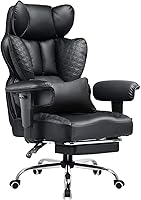
Choose Indulgear for a padded executive chair with lower back firmness you can change and arms that flip behind the chair. It rocks but does not recline.
Pros
- Pump adjusts lumbar firmness
- Arms flip behind the chair
- Pocket spring seat cushion
Cons
- No reclining function
- Backrest angle does not adjust independently
Indulgear suits someone who wants a padded executive chair with adjustable lumbar firmness. Its inflatable support lets you change how full the lower back area feels, rather than relying on one fixed cushion shape.
The pocket spring seat gives it a different construction from a foam-only chair. Start with modest lumbar inflation so you can reach the backrest without feeling pushed toward the front edge.
Its 5D arms can flip behind the chair, giving you open sides when arm pads get in the way. That is useful if you switch between supported typing and tasks that need more elbow room.
Skip it if independent recline is essential. This chair rocks, but the backrest angle does not adjust independently, so it is a work-and-rock choice rather than a reclining lounge chair.
Allow for an overall width of 32.7 in and depth of 24.8 in. The movable arms help with access, but the chair still needs room to turn beside drawers and nearby furniture.
MAHOMICO: mesh-back seating for higher weight requirements
MAHOMICO 750 lb Chair
- 750 lb maximum weight recommendation
- Mesh back
- Oversized U-shaped seat cushion
- 4D armrests
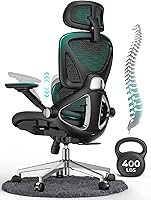
MAHOMICO suits buyers who need this group's highest stated capacity and prefer a mesh back. Its adjustable arms and lumbar support help tailor the working position.
Pros
- Highest stated capacity in this group
- Mesh back allows airflow
- 4D armrests and 2D lumbar adjustment
Cons
- Usable seat dimensions need confirmation
- Requires assembly
MAHOMICO is the choice here for buyers who need the highest stated capacity, 750 lb, and want airflow through the backrest. Its mesh back is paired with an oversized U-shaped padded seat, rather than a mesh seat.
The 4D armrests and 2D lumbar support give you several ways to tailor your working position. These adjustments are useful if you need the forearm pads near your body while keeping the lower back supported.
Choose it over a padded executive design when warmth against your back is a recurring concern. The cushioned seat remains a separate contact surface, so a mesh back does not mean airflow beneath your thighs.
Skip it if you want a fully padded back or need arms that specifically flip out of the way. Several directions of arm adjustment do not establish that the arms fold away.
Its overall width is 29.9 in and depth is 23.6 in. Use those figures for floor planning, then confirm the actual sitting area before choosing it for hip or thigh clearance.
BOSMILLER: padded seating without spring coils
BOSMILLER 650 lb Chair
- 650 lb stated capacity
- High-density sponge padding
- Adjustable lumbar support
- Integrated armrests
BOSMILLER suits buyers who prefer foam padding over a spring cushion. Its leather upholstery, high back and adjustable lumbar support form a padded executive design.
Pros
- Foam seat without spring coils
- Adjustable lumbar support
- Height and tilt adjustments
Cons
- Usable seat dimensions need confirmation
- Arm movement needs clarification before buying
BOSMILLER suits buyers who prefer a foam seat rather than spring-based cushioning. It combines high-density elastic sponge padding, leather upholstery and a high back, with a stated capacity of 650 lb.
That construction is a reason to consider it if you already know you like foam padding. It does not establish a particular firmness, so avoid assuming that the absence of coils means either a softer or harder seat.
Adjustable lumbar support lets you change the lower back contact, while height and tilt controls support changes in working position. The reinforced metal base completes the executive chair design.
Skip it if cooling airflow is your main need, since the back is covered rather than mesh. Buyers who need precise arm positioning should also clarify the available movement before choosing this model.
Its backrest is 22.8 in wide, but that is not usable seat width. Measure the space you need between the arm supports instead of using the backrest measurement as a substitute.
WAILOR: an executive chair for a desk in a shared room
WAILOR 450 lb Executive Chair

- 450 lb weight capacity
- Spring cushion
- High back
- Flip-up arms
WAILOR suits a desk that shares space with other activities, where lifting the arms can help with storage. It combines a spring cushion with a padded high back.
Pros
- Flip-up arms help with desk clearance
- Spring cushion
- WAILOR offers a one-year warranty
Cons
- Lowest stated capacity in this group
- Adjustable lumbar support is not specified
WAILOR suits someone who needs a padded chair that can tuck closer to a desk when work ends. Its flip-up arms remove one common obstacle to sliding a chair beneath a tabletop.
The spring cushion and high back suit buyers who want covered, cushioned seating rather than a mesh back. WAILOR describes the PU leather surface as stain resistant and waterproof, though spills should still be wiped away promptly.
Its stated capacity is 450 lb, the lowest in this group. Choose it only if that limit covers your weight; the fold-away arms are not a reason to compromise on capacity.
Skip it if adjustable lumbar support is essential, because that function is not specified. A high padded back and a movable lower back support serve different needs.
The chair measures 28.54 in wide, 22.65 in deep and 44.09 in high overall. Check the underside of your desk as well as the room around it, since raised arms cannot solve every clearance problem.
BLISNEST: a mesh back with a more shaped cushion
BLISNEST 700 lb Chair

- 700 lb stated capacity
- Mesh back
- W-shaped seat cushion
- 4D armrests
BLISNEST pairs a mesh back with a shaped foam-and-spring cushion. Choose it if you want seat contouring alongside adjustable lumbar panels and padded 4D arms.
Pros
- Mesh back
- Foam cushion with 28 spring pockets
- Lumbar panels adjust vertically and forward or back
Cons
- Pronounced seat contour may not suit everyone
- Assembled dimensions need confirmation
BLISNEST suits buyers who want a contoured seat alongside adjustable back support. Its W-shaped cushion combines high-density foam with 28 spring pockets, paired with a mesh back and a stated capacity of 700 lb.
The cushion shape matters more than the thickness alone. A pronounced contour can suit someone who likes defined sitting areas, while someone who shifts sideways often may prefer a flatter surface.
The lumbar panels move vertically and forward or backward, and the padded arms offer 4D adjustment. This combination is worth considering when back support placement matters as much as seat padding.
Skip it if you dislike shaped cushions or need confirmed recline lock positions. BLISNEST describes rocking movement up to 135 degrees with adjustable tension, which does not establish that every angle locks.
Confirm assembled dimensions before planning desk clearance. The compact dimensions supplied for this model are not a useful basis for judging how much space the chair occupies in use.
NYOAK: wide padded seating with pump-adjusted support
NYOAK 700 lb Chair

- 700 lb maximum weight recommendation
- Inflatable lumbar support
- Extra-wide padded seat
- Flip-up arms
NYOAK suits buyers seeking a wide padded executive design with pump-adjusted lumbar firmness. Flip-up arms offer open sides when you want more room.
Pros
- Inflatable lumbar support
- Flip-up arms
- Waterfall seat edge
Cons
- Usable seat width needs confirmation
- Flip-up arms do not establish several directions of adjustment
NYOAK suits buyers who want a padded executive design with open-side access. It pairs an extra-wide high-density foam seat with flip-up arms and inflatable lumbar support, with a maximum weight recommendation of 700 lb.
The pump changes lower back firmness, while the waterfall seat edge curves away at the front. That edge shape is worth considering if a sharply defined seat front bothers the backs of your thighs.
Choose this model if you want that feature combination with foam seating rather than Indulgear's spring cushion. The flip-up arms also let you remove the arm pads from your sitting space.
Skip it if you need precise arm pad positioning in several directions. Flip-up movement is useful for clearance, but it serves a different purpose from moving a pad inward toward your elbow.
Its overall dimensions are 29.53 in wide, 29.53 in deep and 50 in high. Leave enough room behind the desk to roll back and stand without hitting a wall or cabinet.
What measurements matter before buying a heavy duty office chair?
Check usable seat width, seat depth, working height and desk clearance before choosing among chairs that meet your weight requirement. These measurements decide whether you can sit against the backrest and reach your work comfortably.
Separate the load limit from body fit
Stay within the chair's stated weight capacity. Do not treat a higher number as proof of a wider seat, stronger upholstery or a longer service life.
If several people will share the chair, it needs to accommodate each person's weight and working position. A chair that fits the largest user may still sit too high or too deep for someone smaller.
Avoid choosing an arbitrary amount of extra capacity instead of checking dimensions. First meet the load requirement, then spend your attention on the parts your body touches.
Measure the space between the arms
Usable width is the room available to sit, not the chair's widest outside measurement. Arm supports and thick side padding can reduce that room.
Use a chair that already fits as a reference and measure its clear sitting width. Allow room for your thighs and normal movement without choosing a seat so wide that reaching the arm pads pulls your elbows outward.
Match seat depth to your legs
You should be able to sit against the backrest with a small gap between the seat edge and the backs of your knees. A deep seat can keep a shorter user from reaching the back support.
A seat that is too short leaves more of the thighs unsupported. Do not rely on a tall backrest to solve either problem, because back height does not change seat depth.
Check the working height under your weight
Seat height should let you support your feet while reaching the desk with relaxed shoulders. Thick cushions compress when occupied, so the working position matters more than the empty chair's appearance.
If the desk requires a higher seat position, a stable footrest may help support your feet. Raising the chair until your legs hang is not a useful trade for getting your elbows level with the keyboard.
Check movement around the desk
Measure the desk opening between legs, drawers and crossbars, then check the clearance underneath. Include space to turn, roll back and stand up.
Flip-up arms help when arm pads hit the desk, but they do not shrink the base or backrest. A chair that fits beneath the tabletop can still block a walkway when pulled out.
Which seat, back and arm design suits your workday?
Choose materials for your room and adjustments for your tasks. A mesh back, thick cushion and folding arm each solve a different problem.
Mesh backs versus padded backs
Mesh allows air to move through the backrest, making it the more direct choice if your back gets warm. The mesh options here still have padded seats, so separate back comfort from seat comfort.
A padded back suits someone who prefers a cushioned contact surface. Covered upholstery also needs care around heat, sharp objects and cleaning products, regardless of how substantial the chair looks.
Foam, springs and shaped cushions
Foam and spring cushions describe construction, not a guaranteed firmness. Cushion depth, shape and how your weight compresses the seat all affect the sitting position.
Pay attention to raised edges and contours if you move between different seated positions. Extra thickness is not automatically helpful if it leaves the seat too high or creates pressure beneath your thighs.
Arm movement for typing or storage
Adjustable arm pads help position your forearms; folding arms help clear space. Decide which task matters more before comparing labels such as 4D or 5D.
For typing, your elbows should stay near your body without forcing your shoulders upward. If the pads stop you from getting close enough to the keyboard, move them aside rather than reaching forward all day.
Lumbar firmness versus lumbar placement
Inflatable support changes how full or firm the lower back area feels. Moving panels can change where support meets your back, so these systems are not interchangeable.
Start with gentle contact instead of the strongest setting. If support pushes you forward or presses at the wrong height, more pressure is unlikely to improve the fit.
How should you assemble and adjust a heavy duty chair?
Follow the chair's assembly instructions, then adjust the seat, back support and arms in that order. Good setup keeps one poor adjustment from distorting the rest.
Assemble without forcing the hardware
Lay out the parts and identify the correct fasteners before starting. Protect the floor and ask another adult to help position bulky parts if you cannot hold them securely.
Start bolts by hand and follow the instructed tightening sequence. Forcing a misaligned bolt can damage its threads, while tightening one side too early can make the remaining holes harder to align.
Indulgear specifically calls for a final wrench check after using electric tools. Use the supplied instructions for your model, and see our office chair assembly guide for help with the general sequence.
Set the seat before the arms
Sit back fully, set the height and check foot support before moving the arm pads. Keep the keyboard and mouse close enough that your elbows do not drift forward to reach them.
Next, adjust lumbar contact gradually and bring the arms into a position that supports relaxed shoulders. Our guide to adjusting an office chair explains how these settings work together.
Learn the movement controls gradually
Identify the height, tilt and tension controls before leaning back. Change tension in small steps while seated securely, following the instructions for the mechanism.
Rocking, back recline and recline locks describe different functions. Do not force the backrest or assume a lever provides a feature that the chair does not have.
Build movement into the workday
Change position and take brief standing or walking breaks rather than trying to hold one posture all day. A chair can support sitting, but a high capacity does not make uninterrupted sitting more useful.
If discomfort persists after sensible adjustments, reassess the seat dimensions and desk height. Seek medical advice for ongoing back pain rather than relying on stronger lumbar pressure.
How do you care for a heavy duty office chair?
Keep the wheels clean, hardware secure and upholstery dry, using the chair's care instructions. Routine checks also help you notice changes before they interfere with daily use.
Remove hair and debris from casters so the wheels can turn freely. Grit caught around a wheel can affect rolling and scratch a floor even when the wheel material is soft.
Wipe spills promptly and use only cleaning methods suitable for the upholstery. Avoid soaking seams or applying harsh cleaners to a covered seat.
Inspect accessible bolts and connections at the intervals in the instructions. If the chair develops a crack, persistent wobble or unreliable height control, stop using it until the cause is resolved.
Use replacement parts that match the chair's fit and load requirements. A cylinder or caster that physically attaches is not automatically suitable for the chair.
Which buying mistakes should you avoid?
Avoid choosing by capacity alone or assuming every large chair reclines. Most preventable mistakes come from confusing one measurement or function with another.
- Using outside width as seat width: measure the clear area between the arms, where your body actually sits.
- Choosing the thickest cushion automatically: extra padding can change working height without solving a poor seat shape.
- Expecting a folding arm to adjust like a 4D arm: folding clears space; pad adjustment helps place your forearm support.
- Assuming rubber wheels remove every floor concern: debris, flooring finish and concentrated loads still matter.
- Buying for one posture: check typing access, upright back support and room to stand, rather than judging only a relaxed seated position.
Also check the return process before committing to a bulky chair. Keep packaging until you know the seat dimensions and controls suit your setup.
Which heavy duty office chair should you choose?
Choose your heavy duty office chair by the fit requirement you cannot compromise on, then select the seat and support style you prefer. Eliminate chairs with unsuitable dimensions even if their feature lists look appealing.
Pick Indulgear for padded seating with adjustable lumbar firmness and arms that move behind the chair. Choose MAHOMICO when you need the highest stated capacity here and prefer a mesh back.
Choose BOSMILLER for foam-only seat padding, or WAILOR for a spring-cushion executive chair with folding arms when its capacity meets your needs. Pick BLISNEST if a shaped cushion and movable lumbar panels suit you.
Consider NYOAK when you want a wide foam seat with pump-adjusted support and flip-up arms. Before ordering any model, use our office chair seat measurement guide to check the dimensions against your body and desk.
Our top 3 picks at a glance
-
1
Best for adjustable support seekers
Indulgear 600 lb Heavy Duty Chair
7.8/10 our score
See it on Amazon -
2
-
3
Frequently asked questions
What makes an office chair heavy duty?
A heavy duty office chair combines a stated weight capacity with construction intended for that load, including its base, frame and lift. The term alone does not establish a shared quality standard.
Check the chair's capacity, usable seat dimensions and adjustment range before deciding whether it suits your daily work.
Is a 600 lb office chair automatically better than a 450 lb chair?
No. A higher capacity expands the supported weight range, but it does not establish better comfort, materials or fit.
If both chairs cover your weight, choose between them by seat dimensions, working height, arm placement and back support.
Do not exceed a chair's stated limit to get a preferred feature.
Should I choose a mesh or padded heavy duty chair?
Choose a mesh back if airflow against your back is a priority, or a padded back if you prefer a cushioned surface. MAHOMICO and BLISNEST combine mesh backs with padded seats, so they are not full-mesh chairs.
Compare the seat shape separately, since that determines where your thighs and hips rest.
How do I check whether a heavy duty chair will fit my desk?
Measure the desk opening, underside clearance and available floor space, then compare them with the chair's working height and overall dimensions. Arms must clear the desk without forcing your shoulders upward.
Our guide to office chair seat height and seat depth explains how to compare those measurements with your body.
Does a high weight capacity guarantee a comfortable fit?
No, capacity describes a load limit rather than a body shape. You still need enough room between the arms, a seat depth that lets you reach the backrest, and a height that supports your feet.
A wide chair can also fit poorly if its arms sit too far apart.