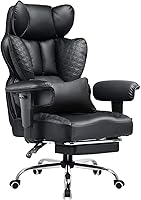
Office Chair Weight Capacity: What the Number Means
An office chair with 400 lb capacity supports up to the maker's stated weight limit. Choose by usable seat space, height range, and desk fit, then compare support features and warranty coverage.
On this page (8 sections)
- What does an office chair with 400 lb capacity mean?
- How do you check seat fit before buying?
- Which parts and adjustments deserve the closest look?
- Does a 400 lb rating mean the chair is BIFMA certified?
- Which 400 lb chair suits your workday?
- How should you assemble and adjust a new chair?
- What care habits help keep the chair usable?
- Which office chair with 400 lb capacity should you choose?
An office chair with 400 lb capacity supports up to the maker's stated weight limit, but you should choose it by seat fit and desk fit first. CAPOT suits adjustable mesh support, HYLONE suits a padded seat with flip-up arms, and WAILOR suits reclining breaks.
The right choice lets you sit back, rest your feet, and reach your keyboard without squeezing between the arms. A large capacity number cannot make a narrow seat or poorly placed backrest fit your body.
What does an office chair with 400 lb capacity mean?
It means the brand rates the chair to support up to 400 lb under its use instructions. It does not promise a certain seat width, comfort level, or number of years of service.
If you weigh close to that limit, consider a higher-capacity chair and check the brand's guidance. Don't assume an allowance above the stated maximum or apply a made-up rule about how much spare capacity every chair needs.
Capacity also doesn't make every part a step or support handle. Unless the instructions allow it, don't stand on the seat, sit on an armrest, or use the backrest to lift yourself from another chair.
How do you check seat fit before buying?
Check usable seat width, seat depth, and arm spacing against a chair that already fits you. Overall furniture dimensions can include the back, arms, or base, so they aren't a substitute for seat measurements.
Measure the space you need across your hips while wearing your usual work clothes. Allow room to shift position without the arm supports pressing against your sides.
With your back against the backrest, the seat should support your thighs while leaving a small gap behind your knees. A seat that's too deep can push you forward and leave the back support out of reach.
Check the height range too: your feet need firm support while your shoulders stay relaxed at the desk. Our seat height and seat depth guide explains how those measurements work together.
For broader sizing advice, read our big and tall office chair guide. Our best big and tall office chairs also covers alternatives if these shapes don't suit you.
Which parts and adjustments deserve the closest look?
Compare the base, lift, arms, and back controls after confirming the seat fits. Useful adjustments let you reach your work comfortably without forcing you into one position.
- Base footprint: Make sure it fits beneath the desk and has room to turn without catching cabinets or nearby furniture.
- Arm movement: Flip-up arms help with desk clearance, but they don't automatically provide the right elbow height.
- Back controls: Check which positions lock and whether you can reach the controls while seated.
- Headrest position: It should meet your head comfortably rather than push your neck forward.
- Parts coverage: Read which components are covered, how to request replacements, and any conditions that apply.
A footrest can help during a reclined break, but it doesn't replace floor support while typing upright. Likewise, a thick cushion describes construction, not how well it will suit your body.
Does a 400 lb rating mean the chair is BIFMA certified?
No, capacity and certification are separate claims. A weight limit by itself doesn't establish that the whole chair meets a furniture standard.
BIFMA develops standards for business and institutional furniture. Check the named standard and exact model rather than treating a certified gas lift as certification of the complete chair.
Our guide to what BIFMA certification means explains the terms. Certification can help you compare construction claims, but you still need to check personal fit.
Which 400 lb chair suits your workday?
Choose CAPOT for mesh seating, HYLONE for a foam seat, or WAILOR for recline-focused breaks. Their different surfaces and controls matter more to daily use than their shared capacity.
CAPOT office chair with 400 lb capacity: who should choose it?
Choose CAPOT if you want a mesh seat and several support adjustments for desk work. Its lumbar support moves through 8 levels over 2 in, while the headrest adjusts in height and depth.
The seat measures 20 in wide by 19.3 in deep, with a height range of 18.5 to 22.05 in. CAPOT recommends the chair for people from 5 ft 5 in to 6 ft 2 in, though your leg and torso lengths still matter.
The arms flip up, and the back locks at 90°, 110°, or 125°. CAPOT backs the chair with a 5-year warranty and complimentary part replacements.
Skip it if you want a thick foam sitting surface or need a lower seat than its minimum height. The measured seat depth also deserves attention if deep seats usually keep you from reaching the backrest.
Who should choose the HYLONE padded-seat chair?
Choose HYLONE if you prefer a cushioned seat with a mesh back and want arms that move out of the way. Its 5 in thick sponge cushion makes it a different choice from CAPOT's mesh seat.
The chair has a 28 in base, adjustable seat height and backrest, and 24 months of free parts from HYLONE. Measure the base footprint against your desk opening and the space available to turn.
HYLONE recommends it for people about 5 ft 5 in to 6 ft 2 in. Confirm usable seat dimensions and the seat-height range before ordering, especially if you need extra hip room or use a low desk.
Skip it if you need a mesh sitting surface or can't confirm those fit measurements. Don't choose it for a standing-height counter without checking that its actual height range reaches your work surface.
Who should choose the WAILOR reclining chair?
Choose WAILOR if you want a padded executive chair for work and reclined breaks. It has PU leather upholstery, a layered foam seat, and an adjustable headrest.
The back reclines from 90° to 155°, with linkage arms that move with it. WAILOR describes the retractable footrest as optional, so confirm that your selected version includes it.
WAILOR provides a metal frame and a 1-year warranty. Leave clear space behind the backrest and in front of the seat for the movement you intend to use.
Skip it if airflow through the sitting surface is your priority or your desk requires flip-up arms. Linkage arms serve a different purpose, and recline features won't compensate for a seat that doesn't fit.
How should you assemble and adjust a new chair?
Follow the supplied assembly order, then adjust the chair at your actual desk. Start bolts as directed before tightening them fully so connected parts can line up correctly.
Keep packaging and spare hardware until assembly is complete. Our office chair assembly guide covers preparation and common mistakes.
Before sitting, check that the casters and lift are seated as instructed and that all required fasteners are secure. Start upright, then try the controls gradually with clear space around you.
Set the seat height so your feet rest firmly, then bring the chair close enough to avoid reaching for the keyboard. Adjust lumbar support to your lower back and move the arms so they don't raise your shoulders.
For a full setup sequence, follow how to adjust an office chair. Change one control at a time so you can tell which adjustment helps.
What care habits help keep the chair usable?
Keep moving parts clear and check loose connections when movement changes. Follow the brand's care instructions for upholstery, mesh, hardware, and any lubrication.
Remove hair and debris from the casters, and clean surfaces gently with approved methods. Don't soak the seat or apply strong cleaners without checking whether they're suitable for the material.
If the chair develops a wobble, inspect the assembly connections before continuing to use it. Stop using it if a base, caster, lift, or support part is damaged, and contact the brand about a suitable replacement.
Even a well-fitted chair benefits from changes in position. Stand or walk at intervals rather than relying on more padding or a deeper recline to make one sitting position work all day.
Which office chair with 400 lb capacity should you choose?
Choose CAPOT for adjustable mesh support, HYLONE for a foam seat with flip-up arms, or WAILOR for a padded chair with reclining breaks. Rule out any option whose usable seat space, height range, or arm clearance doesn't fit you.
If you're near the capacity limit or need more room than these options provide, broaden the search before ordering. Our heavy-duty office chair guide is the next place to compare alternatives.
If both surfaces suit your measurements, use our mesh versus leather office chair comparison to settle the material choice. Buy the chair that fits your working position first, then choose the extras you'll use.
Frequently asked questions
What does 400 lb capacity mean on an office chair?
It means the maker rates the chair to support up to 400 lb under its use instructions. That limit does not describe usable seat space, comfort, or service life, so compare seat width, seat depth, arm spacing, and height adjustments before choosing a chair.
Is a 400 lb office chair right for someone who weighs 400 lb?
At 400 lb, you are at the chair's stated maximum, so consider a higher-capacity model and check the brand's guidance. There is no single extra-capacity allowance that fits every chair, and a higher limit still needs to come with seat dimensions and adjustments that suit you.
Does a 400 lb capacity mean every part of the chair is reinforced?
No, a weight limit does not describe how each part is built. Compare the base, frame, lift, casters, and adjustment mechanism, then read the assembly instructions and warranty coverage, since a chair's capacity alone does not tell you which replacement parts the brand will provide.
How do I choose between a mesh and leather 400 lb chair?
Choose mesh if airflow through the seat or back matters most, and choose padding if you prefer a cushioned sitting surface. Check the actual seat material because a mesh back can come with a foam seat, and compare dimensions and adjustments before deciding on either style.