7 Best Mesh Office Chairs (October 2026)
The best mesh office chairs include the Marsail Ergonomic Office Chair for mixed desk tasks, the SIHOO M18 Ergonomic Chair for taller desk workers, and the SIHOO M57 Ergonomic Chair for changing work postures.
On this page (8 sections)
- How we chose these mesh office chairs
- Which mesh office chair fits your priorities?
- What should you measure before buying a mesh office chair?
- Should you choose a mesh seat or a foam cushion?
- How should you set up a mesh chair for desk work?
- Which buying and sitting mistakes should you avoid?
- How do you care for a mesh office chair?
- Which mesh office chair should you choose?
The Marsail Ergonomic Office Chair is our top mesh office chair pick for buyers who want adjustable back support, movable arms and a foam seat. Choose SIHOO B100 for reclining breaks, or CAPOT when you need a higher weight capacity and its seat dimensions fit you.
Start with seat fit and desk clearance before comparing extra controls. A breathable back won't solve a seat that presses behind your knees or arms that keep you too far from the keyboard.
For other chair styles, see our guide to the best ergonomic office chairs for a home office. The picks below focus on mesh backs, with different ways to support your working position.
Our picks at a glance
-
1

-
2

-
3
How we chose these mesh office chairs
We compared seat construction, lumbar movement, arm adjustment, recline and capacity, with fit taking priority over extra features. Marsail leads because it combines several useful controls with a padded seat and arms that move out of the way.
The scores rank each chair's feature mix for this comparison. A lower-ranked chair can still be your better choice when its seat material, support controls or capacity meets a specific need.
Use the ergonomic mesh chair category to keep exploring this chair style. For this shortlist, the comparison below highlights the differences worth checking before you choose.
| Product | Best for | Lumbar adjustment | Recline | Weight capacity | Our score |
|---|---|---|---|---|---|
| Marsail Ergonomic Office Chair | mixed desk tasks | 1.18 in forward/back and 2.16 in up/down | 90° to 120° | 330 lb | 9.1 |
| SIHOO M18 Ergonomic Chair | taller desk workers | Adjustable | 150 kg | 8.8 | |
| SIHOO M57 Ergonomic Chair | changing work postures | Height and depth | 90° to 126° | 330 lb | 8.6 |
| SIHOO B100 Mesh Chair | reclining breaks | 110°, 125° or 135° | 300 lb | 7.9 | |
| HOLLUDLE Ergonomic Mesh Chair | precise back positioning | Height, depth and rotation | 7.7 | ||
| FelixKing Mesh Office Chair | shared-use desks | Adjustable | 300 lb | 7.7 | |
| CAPOT 400 lb Mesh Chair | heavier desk workers | 2 in across 8 levels | 400 lb | 7.6 |
Which mesh office chair fits your priorities?
Choose Marsail for broad adjustability, then consider the other picks for a specific reason to change course. Each section explains who benefits from that chair and which tradeoff should make you skip it.
Marsail Ergonomic Office Chair
- Height-and-depth lumbar adjustment
- 3.14 in high-density foam seat
- 90° to 120° recline
- Adjustable headrest and flip-up arms
Choose Marsail for a foam seat and several ways to position your back, arms and head. Its flip-up arms also help you move closer to a desk.
Pros
- Lumbar support adjusts in height and depth
- Arm pads move forward, backward and swivel
- Armrests flip up
Cons
- Less recline than the M57 and B100
- Foam seat won't suit buyers seeking mesh beneath them
Marsail mesh office chair: for mixed desk tasks
Marsail suits people who alternate between typing, reading and leaning back and want to adjust several contact points. Its lumbar panel moves 1.18 in forward and backward and 2.16 in up and down, letting you change both placement and pressure.
The mesh back pairs with a 3.14 in high-density foam seat. Choose that combination if you want airflow behind you without giving up cushioning beneath your hips.
The padded armrests move forward and backward, swivel and flip up. That makes them useful when you switch from keyboard work to writing or need to bring the seat closer to the desk.
Its adjustable headrest and 90° to 120° recline cover work and modest leaning-back positions. Skip it if you specifically want a mesh seat or a deeper resting angle.
During setup, position the lumbar panel gently against your lower back before adding more forward pressure. More pressure isn't automatically better, especially if it pushes you away from the backrest.
SIHOO M18 Ergonomic Chair
- Suggested height range provided
- Adjustable headrest and lumbar support
- Mesh backrest with cushioned seat
- 2D armrests
The M18 gives buyers a suggested height range alongside adjustable back and neck support. It suits shoppers who prefer a cushioned seat beneath a mesh back.
Pros
- Suggested user height range provided
- Adjustable headrest and lumbar support
- SIHOO provides a 3-year warranty
Cons
- Less armrest adjustment than 3D alternatives
- Suggested height range excludes shorter buyers
SIHOO M18: for buyers within its height range
The M18 suits buyers who want a clear height starting point and adjustable support without prioritizing multi-direction arm pads. SIHOO suggests it for people from 5 ft 6 in to 6 ft 2 in.
That range helps narrow the field, but people of the same height can have different thigh and lower-leg lengths. Check whether you can sit against the backrest with supported feet rather than assuming your height settles the decision.
The M18 combines a mesh back with a cushioned seat, adjustable lumbar support and an adjustable headrest. Its 2D arms offer fewer positioning options than the 3D arms on the M57.
SIHOO gives it a maximum capacity of 150 kg and a 3-year warranty. Keep warranty information and assembly records somewhere easy to find if you later need parts.
Skip the M18 if you're below its suggested height range or need more arm-pad movement around a wide keyboard setup. A stated user range is most useful as an early filter, not a promise of personal comfort.
SIHOO M57 Ergonomic Chair
- 90° to 126° recline
- Height-and-depth lumbar adjustment
- 3D armrests
- Height-and-angle headrest adjustment
The M57 combines adjustable back support and arm positioning with room to lean back between desk tasks. Its headrest lifts and tilts.
Pros
- Lumbar support adjusts in 2 directions
- 3D armrests
- Waterfall seat edge
Cons
- No flip-up arm function specified
- Less maximum recline than the B100
SIHOO M57: for changing work postures
The M57 suits people who want adjustable support for both upright work and leaning back. Its lumbar support moves in height and depth, while the headrest lifts and tilts.
The 3D armrests give you more ways to position your forearms around your keyboard and mouse. Set them so they support your arms without lifting your shoulders or forcing your elbows outward.
Its recline runs from 90° to 126°, offering more backward travel than Marsail. That can suit reading or a phone call, provided you have clearance behind the chair.
The M57 also has a reinforced aluminum base and a waterfall seat edge. The curved front edge is worth considering if you dislike a pronounced edge beneath your thighs, though seat depth still needs to fit.
Choose it when arm positioning and manual lumbar adjustment matter together. Skip it if folding the arms away is essential, since a flip-up function isn't specified for this model.
SIHOO B100 Mesh Chair

- Adaptive lumbar support
- Three lockable recline angles
- Adjustable headrest
- Flip-up armrests
Choose the B100 when leaning back between tasks matters more than having a specified upright lock. Its adaptive lumbar support is designed to follow posture changes.
Pros
- Deepest specified recline in this group
- Flip-up arms clear the sides
- Seat-height range provided
Cons
- Lowest specified recline lock is 110°
- Higher minimum seat height may exclude shorter users
SIHOO B100: for reclining breaks
The B100 suits buyers who deliberately use their chair for leaning-back breaks. Its 3 lockable recline positions are 110°, 125° and 135°, making it the deepest reclining option in this group.
The important tradeoff is the first specified lock position. If you want a clearly defined upright lock for typing, favor a chair with that position rather than assuming the B100 provides it.
SIHOO describes its lumbar support as adaptive, designed to follow changes in posture. Choose this approach if you prefer support that moves with you over repeatedly changing manual settings.
Seat height adjusts from 18.3 to 21.9 in, and the arms flip up. Measure your current comfortable seat height, because a minimum that is too high can leave your feet unsupported.
Skip it if you need a lower seat or require precise manual control over lumbar depth. Its 300 lb capacity also rules it out for anyone needing a higher limit.
HOLLUDLE Ergonomic Mesh Chair

- Lumbar height, depth and rotation adjustment
- 3D armrests
- Three-level tilt lock
- Adjustable headrest
HOLLUDLE adds lumbar rotation to height and depth adjustments. It suits buyers who want to fine-tune support placement and arm position separately.
Pros
- Lumbar support rotates
- Armrests adjust in height, reach and angle
- HOLLUDLE provides a 5-year warranty
Cons
- More controls to set up
- No flip-up arm function specified
HOLLUDLE: for precise back positioning
HOLLUDLE suits buyers who want to fine-tune the angle as well as the position of their lumbar support. Its support moves vertically, moves forward and backward, and rotates.
The armrests adjust in height, reach and angle, while the headrest moves up and down and rotates. These separate controls give you more ways to position the chair around your body and work surface.
Its mesh V-shaped back is paired with a foam-filled seat, and a 3-level tilt lock provides resting options. HOLLUDLE states a 350 lb capacity and backs the chair with a 5-year warranty.
Set one control at a time so you can tell which change helps. Start with lumbar height, then depth, and leave rotation until the support meets the right part of your back.
Choose HOLLUDLE if simpler lumbar pads tend to meet your back at the wrong angle. Skip it if you want fewer controls or need arms that fold out of the way.
FelixKing Mesh Office Chair

- Flip-up armrests
- Adjustable lumbar support
- High-density foam cushion
- Adjustable height and tilt
FelixKing suits a desk that switches between computer work and tasks needing clear space at the sides. Its mesh back is paired with a foam cushion.
Pros
- Arms move out of the way
- Adjustable lumbar support
- FelixKing provides a 5-year warranty
Cons
- No multi-direction arm-pad adjustment specified
- Foam seat won't suit buyers seeking a mesh seat
FelixKing: for desks used in different ways
FelixKing suits a desk that switches between computer work and tasks needing clear space beside you. Its flip-up armrests let you bring your elbows closer to your body without arm pads in the way.
A mesh back and high-density foam cushion provide the back-and-seat combination many buyers seek. Adjustable lumbar support, height and tilt cover the main changes you'll make when settling in.
FelixKing gives the chair a 300 lb capacity and a 5-year warranty. Choose it for its layout and cushion rather than expecting the detailed arm positioning offered by the 3D alternatives.
For a shared desk, reset the height and lumbar position each time the user changes. Folding the arms helps clear space, but it doesn't make one person's settings suitable for everyone.
Skip FelixKing if you need a mesh seat or precise arm-pad reach and angle adjustments. It's a clearer match for buyers who value moving the arms away over positioning them in several directions.
CAPOT 400 lb Mesh Chair
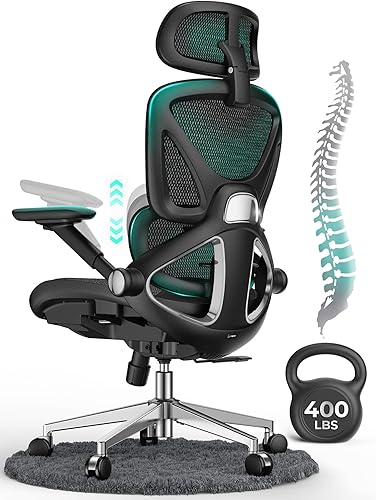
- 400 lb capacity
- Eight lumbar adjustment levels
- Mesh seat
- Adjustable headrest and flip-up arms
CAPOT offers the highest stated capacity here and provides seat measurements for checking fit. Choose it only if its width, depth and height work for your body.
Pros
- Highest stated capacity in this group
- Eight lumbar settings
- Headrest adjusts in height and depth
Cons
- Suggested user height starts at 5 ft 5 in
- Fixed seat depth requires a careful fit check
CAPOT: for higher capacity with a measured fit
CAPOT suits heavier desk workers who also fit its seat dimensions. Its stated 400 lb capacity is the highest here, but the seat measures 20 in wide by 19.3 in deep, so check usable sitting space carefully.
Seat height runs from 18.5 to 22.05 in, and CAPOT suggests a user height range of 5 ft 5 in to 6 ft 2 in. A buyer near the shorter end still needs to check foot support and thigh clearance.
The mesh seat makes this a different choice from the foam-cushioned Marsail and FelixKing. Its lumbar support offers 2 in of adjustment across 8 levels, giving you defined settings to compare.
The backrest locks at 90°, 110° or 125°, with a height-and-depth adjustable headrest and flip-up arms. Skip it if you prefer a padded seat or find that its fixed seat depth leaves too little knee clearance.
For alternatives with different proportions, see our best big and tall office chairs.
What should you measure before buying a mesh office chair?
Measure seat height, usable seat space and desk clearance before comparing recline or headrest features. A few measurements from a chair that already fits can prevent a poor choice.
Check seat depth against your thighs
Sit with your hips against the backrest and leave a small gap between the front edge and the backs of your knees. You should be able to use the back support without the seat pressing into your legs.
A seat that's too deep may encourage you to perch forward, making the lumbar controls less useful. A shallow seat can leave more of your thighs unsupported than you prefer.
Compare usable seat dimensions rather than overall chair depth. Our guide to office chair seat height and seat depth explains how those measurements affect fit.
Check width and arm spacing separately
Allow room for your hips without the seat frame or arm supports pressing against you. Overall chair width includes parts that don't add sitting space, so it isn't a substitute for usable seat width.
Very wide arm spacing can also leave your elbows reaching outward. A chair can offer plenty of hip room yet still put its arm pads too far away for comfortable keyboard work.
Measure the desk opening
Measure beneath the desk at its lowest obstruction, including drawers, support rails and keyboard trays. Then consider both working clearance and whether you want to tuck the chair away.
Flip-up arms help with storage, but they don't lower the seat, backrest or headrest. Leave enough room to pull the chair out without hitting nearby furniture.
Treat capacity as a separate requirement
Stay within the chair's stated weight limit and check dimensions independently. Higher capacity doesn't mean a wider seat, a taller back or more room between the arms.
For the meaning behind those numbers, read our office chair weight capacity guide. Don't use capacity alone to judge comfort or expected lifespan.
Should you choose a mesh seat or a foam cushion?
Choose mesh for an open, ventilated sitting surface or foam when you prefer padding beneath you. Both need a suitable frame shape and seat depth to feel comfortable.
Mesh favors airflow but exposes fit problems
A mesh seat supports you through tension rather than a thick cushion. Pay attention to how its front edge and side frame meet your thighs, especially if you sit near the seat's width limit.
Don't assume all mesh has the same firmness or flexibility. During your first sitting sessions, notice any pressure at the frame rather than judging only the open area in the center.
Foam offers cushioning but changes the feel
A foam seat gives a padded surface beneath your hips and thighs. Its feel also depends on shape and support, so thickness alone doesn't tell you how it will suit a full workday.
A mesh back with a foam seat can be a useful middle ground for someone who gets warm across the back but dislikes suspended seating. That is the main reason to consider Marsail or FelixKing over CAPOT.
Avoid adding a thick seat cushion before adjusting the chair. Raising your sitting position changes where the lumbar support, arms and headrest meet your body.
How should you set up a mesh chair for desk work?
Set seat height first, lumbar support second and armrests third, then check your keyboard and screen position. Starting with accessories or the headrest can hide a basic fit problem.
Begin with supported feet
Sit back and adjust the seat so your feet rest steadily on the floor. Your knees should bend comfortably without the front edge pressing behind them.
If reaching the desk requires a higher seat, a stable footrest can support your feet. Don't keep lowering the chair if that leaves you reaching upward to type.
Place lumbar support without forcing an arch
Move the support toward the inward curve of your lower back. Add depth gradually rather than starting with the strongest setting.
You should be able to lean against the backrest without feeling shoved forward. For adaptive support, check how contact changes as you shift position instead of expecting a manual depth control.
Bring the work toward you
Move the keyboard and mouse close enough that your upper arms can stay near your sides. Then position the arm pads to support your forearms without raising your shoulders.
If the pads hit the desk first, lower or reposition them, or fold them away where possible. Avoid stretching forward from the seat just to keep the arms under the desk.
Set recline and headrest last
Adjust recline controls while seated and follow the chair's instructions for locking and releasing them. Keep the area behind you clear before leaning back.
Position the headrest so it supports you when you lean back without pushing your head forward during upright work. Our guide on how to adjust an office chair gives a fuller setup sequence.
Which buying and sitting mistakes should you avoid?
Avoid choosing by maximum recline, cushion thickness or capacity alone. These details matter only after the chair fits your body and lets you reach your work comfortably.
Don't buy extra adjustments without a use for them
Rotating lumbar support is useful when its angle needs changing, but it adds another control to set. A deeper recline matters if you take reclining breaks and have room behind the desk.
Choose the feature that solves your actual problem. If the arms block your desk, folding arms deserve more attention than another headrest adjustment.
Don't use maximum lumbar pressure as the goal
Back support should provide contact without forcing you into a position you can't comfortably maintain. If you keep sliding forward, reduce the pressure and recheck seat depth.
Changing several settings at once makes the cause harder to find. Make one small change, use the chair for a normal task, and then decide whether another adjustment is needed.
Don't expect one posture to last all day
Even a well-fitted chair doesn't remove the need to move. Alternate tasks, shift your sitting position and take short standing or walking breaks.
Reclining can change how you sit, but it doesn't replace leaving the chair. If sitting causes ongoing pain, ask a health professional for advice.
How do you care for a mesh office chair?
Remove dust gently, clean spills promptly and keep the moving parts clear. Follow the chair's care instructions before applying any cleaner to mesh, padding or plastic.
Clean without stretching the mesh
Use a soft brush or a vacuum's brush attachment with gentle suction to remove crumbs and dust. Don't push a hard nozzle into the mesh or scrape dried debris across it.
For a small spill, blot first rather than rubbing. If damp cleaning is allowed, use minimal moisture and let the surface dry fully before sitting down.
Avoid soaking the seat or using heat to speed drying. Excess moisture can reach padding or mechanisms, while heat can affect surface materials.
Keep wheels and fasteners in order
Remove hair and threads wrapped around the casters before they build up. Debris can make rolling harder even when the chair itself is otherwise working normally.
After assembly and periodically afterward, check accessible fasteners according to the instructions. Tighten them as directed without forcing threads or overtightening plastic parts.
If the seat gradually drops, cleaning and tightening won't address the height mechanism. Our guide explains why an office chair keeps sinking and the next checks to make.
Which mesh office chair should you choose?
Choose the mesh office chair that passes your fit checks first, then use its strongest feature to make the final decision. Extra controls are useful only when you can sit back, support your feet and reach the desk comfortably.
- Choose Marsail for a foam seat and several adjustable contact points across everyday desk tasks.
- Choose SIHOO M18 if you fit its suggested height range and don't need the M57's extra arm positioning.
- Choose SIHOO M57 for manual lumbar adjustment, movable arm pads and changes between upright and reclined work.
- Choose SIHOO B100 for reclining breaks, provided its minimum seat height and specified lock positions suit you.
- Choose HOLLUDLE when lumbar angle is the adjustment you want to fine-tune.
- Choose FelixKing when a padded seat and arms that move away best match how you use your desk.
- Choose CAPOT when you need its higher capacity and have confirmed that the seat dimensions work.
Before keeping any chair, check fit while typing, using the mouse and leaning back. Pressure behind your knees, unsupported feet or shoulders lifted by arm pads are reasons to revisit the setup or choose another size.
For more options in a different spending tier, compare our best budget office chairs. If seat material remains the deciding factor, use the mesh vs leather office chair comparison to settle that choice.
Our top 3 picks at a glance
-
1
-
2
-
3
Frequently asked questions
Are mesh office chairs good for long hours?
A mesh office chair can suit long desk sessions when the seat and back fit your body. Airflow helps with warmth, but it cannot make up for dangling feet, pressure behind your knees or poorly placed arms.
Change position and take movement breaks rather than relying on one sitting posture.
Is a mesh seat better than a foam seat?
A mesh seat favors airflow, while foam gives you a padded surface. Choose by how the seat supports your thighs and whether its front edge feels comfortable.
Marsail and FelixKing have foam cushions; CAPOT has a mesh seat.
Neither material makes an oversized or undersized chair fit correctly.
What adjustments matter most in a mesh office chair?
Seat height, lumbar position and armrest fit matter most for desk work. Start with supported feet, then place the back support against your lower back and keep your shoulders relaxed.
A headrest and deeper recline are useful extras if you lean back, but they won't correct a poor seat fit.
How do I choose between mesh office chairs?
Eliminate chairs that don't fit your seat measurements, desk clearance or required capacity, then compare the controls you'll use daily. Choose foam or mesh beneath you before weighing recline extras.
If back material remains your main question, read our mesh vs leather chair guide for the practical differences.